September 20, 2026

An overseas invader that has really flourished
Flora and fauna – Pineappleweed, Matricaria discoidea
YOU come back from a walk in the country and wash off your boots.
If you were of a mind to sow the boot washings, you would find that after a couple of weeks you had seedlings of pineappleweed growing.
In fact, in the 1960s, just such an experiment was done. A car with scrupulously clean tyres was driven around on country roads, and into the gateways of fields.
On its return, the tyres were washed, and the washings planted into sterile compost. After a few months, 220 specimens of pineappleweed were growing, along with 13 other separate species of flowering plants.
Pineappleweed is a member of the daisy family – possibly the largest plant family of all, with more than 25,000 species (though vying always for first place with the orchid family, where constant new discoveries bring it ever nearer to the daisy’s record number).
It was introduced from North America and, like brambles and rabbits in Australia, this invasive species took every opportunity to spread.
It was first recorded in the UK in 1936, since when it has become common in fields, paths and even in towns.
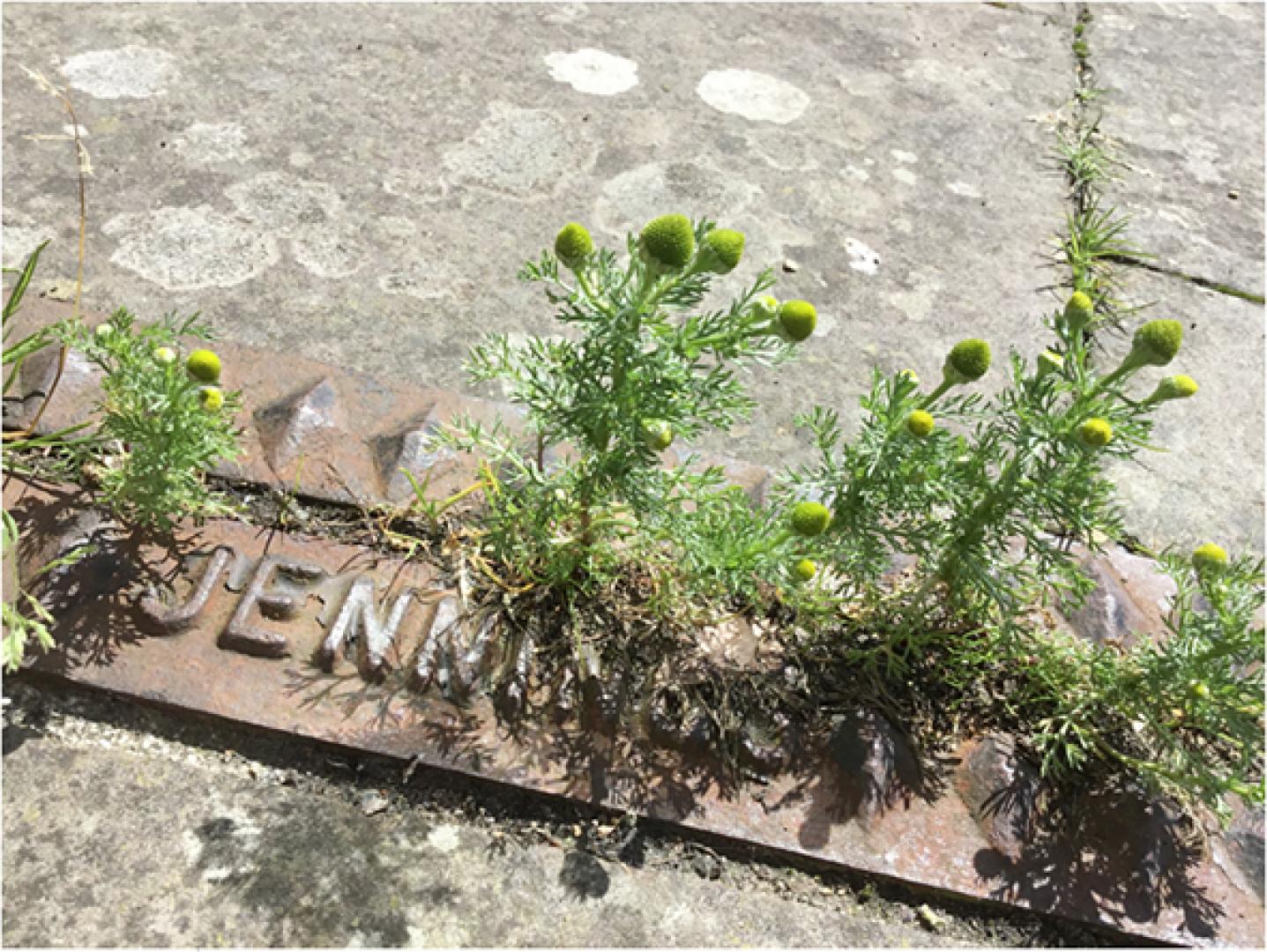
Look at any patch of waste ground, farm gateway or car park between March and September, and you are almost bound to find, in among the grasses, the feathery leaves and densely-packed yellowy green flower heads of pineappleweed.
This photo of the plant growing out of a pavement drain (metalwork by Jennings) was taken on The Bank, in Barnard Castle.
And why the name? I suppose that, by some stretch of the imagination you could see the flower heads as tiny pineapples.
But squeeze one and sniff, and you will clearly discern the scent of pineapple with perhaps a hint of chamomile. Indeed, wild chamomile is one of the names by which this plant is known.
The flowers are edible, and, though bitter by the time the plant blooms, have been used in salads, and to make herbal tea, and also, along with true chamomile, for medicinal purposes.
Chamomile was considered one of the nine sacred herbs of the Anglo-Saxons and was used ritually to ward off diseases and promote health.
The Greek physician and botanist Dioscorides (c40-90AD) used chamomile to heal intestinal, nervous and liver disorders as well as prescribing it for women’s ailments like post-partum anaemia.
(Ladies, please see your doctor instead!)
Dr Richard Warren is a botanist living in Barnard Castle