October 9, 2026

Twelve Angry Men: Powerful message about prejudice and justice
Andrew Harrison is gripped by the latest production
at the Darlington Hippodrome
Twelve men are locked in a stuffy jury room after hearing three days of testimony in the trial of a 16-year-old boy accused of murdering his father.
Initially, they expect a quick verdict, as the evidence appears overwhelming.
The prosecution has presented a clear motive in the boy’s troubled relationship with his father, an eyewitness claims to have seen the stabbing, and neighbours reported hearing a violent argument before the murder.
Before leaving the courtroom, the jurors are reminded that the verdict must be unanimous and that a guilty verdict will result in the death penalty.
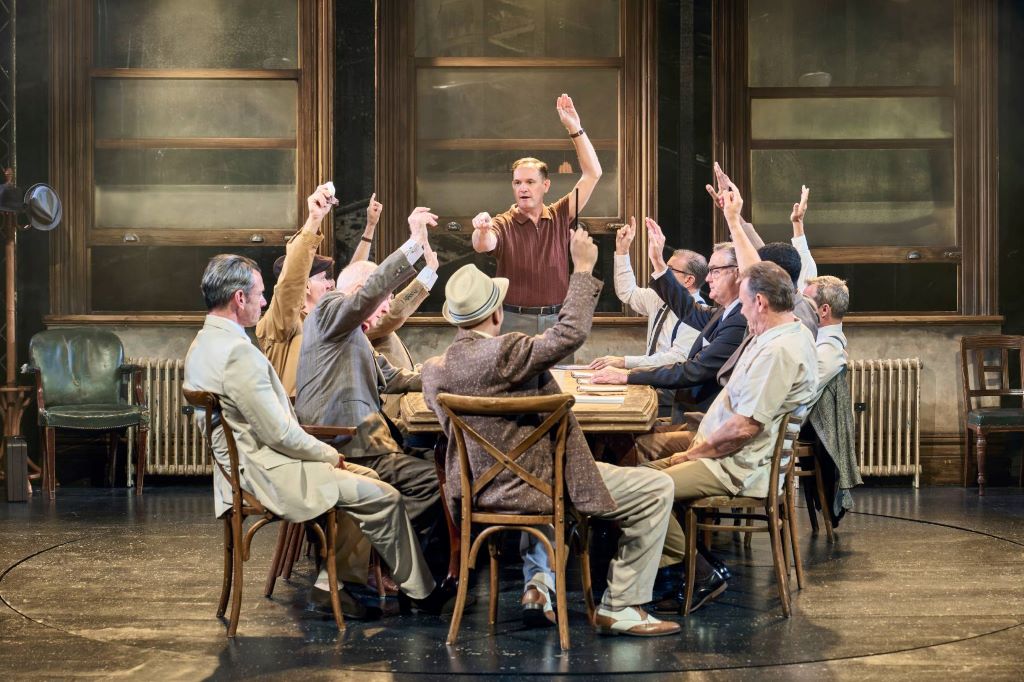
Expecting a swift conclusion, 11 jurors vote guilty, while Juror 8, played by Gary O’Brien, casts the only not guilty vote.
This is not because he believes the boy is innocent, but because he feels the case deserves careful discussion rather than a rushed decision.
The hot, claustrophobic setting reflects the growing tension among the jurors.
As their discussion continues, the room becomes increasingly oppressive.
The men pace restlessly, struggling with the intense heat, while the broken fan symbolises their discomfort and frustration.
The only relief comes from the water cooler in the corner.
The set design effectively heightens the sense of confinement, mirroring the mounting conflict and pressure as the jurors begin to question not only the evidence but also one another.
The jurors’ initial guilty verdicts are heavily influenced by their prejudice towards the boy.
Because he comes from a disadvantaged background, many assume he is capable of committing the crime, demonstrating how bias can affect the pursuit of justice.
As tension among the jurors increases and the oppressive heat of the jury room intensifies, their emotions begin to surface, exposing their personal prejudices and biases.
This leads some jurors to rely on stereotypes rather than the facts of the case.
As a result, they struggle to consider whether there is reasonable doubt, a vital principle when deciding on a verdict that could ultimately lead to a person’s execution.
Bill Ward gives a powerful performance as the hot-headed Juror 3, capturing the character’s anger and stubbornness as he struggles to separate his personal feelings from the facts of the case.
Twelve Angry Men is a gripping and thought-provoking production that keeps the audience engaged throughout, delivering a powerful message about prejudice, justice, and the importance of reasonable doubt.
- Twelve Angry Men runs at Darlington Hippodrome until Saturday October 10