October 13, 2026

Best solar eclipse in 27 years to be visible across the UK next week
A partial solar eclipse, which will be the most visible from the UK in 27 years, is set to take place on Wednesday evening.
More than 90 per cent of the sun will be hidden by the moon during the event, which will happen just hours before a meteor shower.
The eclipse will begin just after 6pm on Wednesday, August 12.
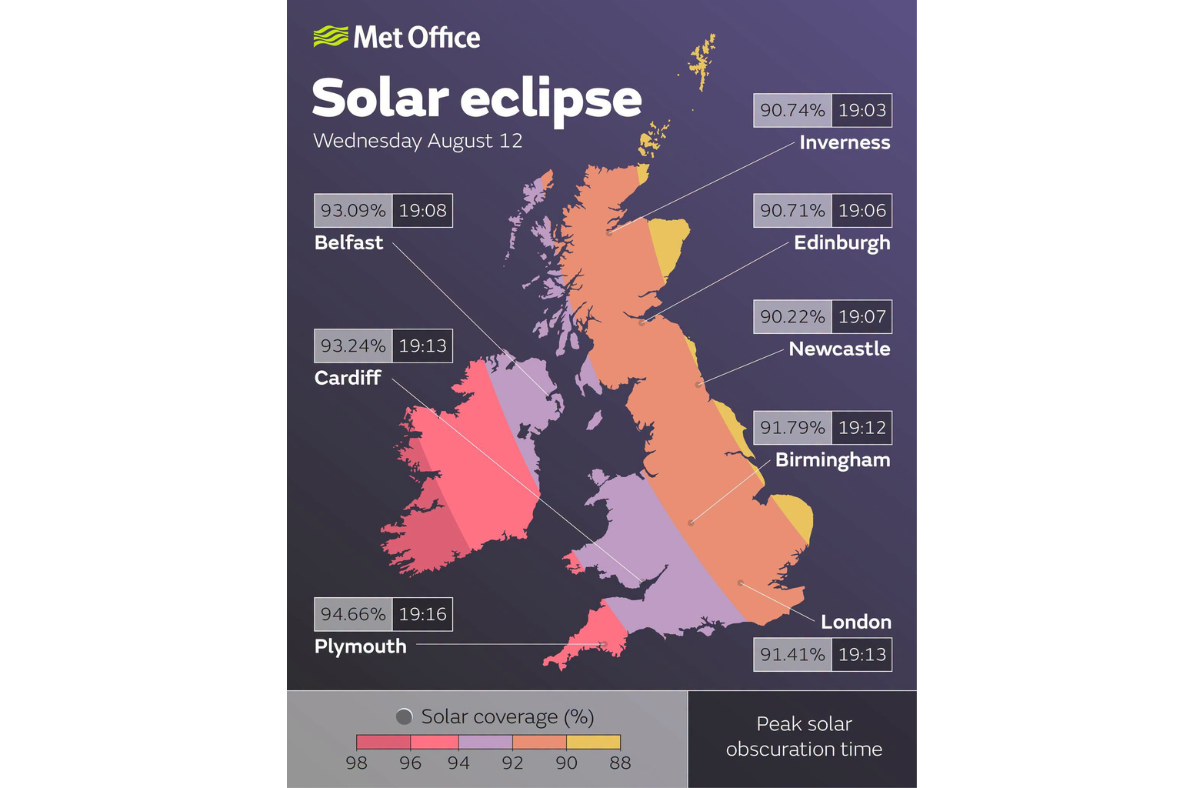
The maximum eclipse will occur between about 7.05pm and 7.13pm, depending on the location.
The Met Office has released a map showing that the further west people are, the more complete the eclipse will be.
Northeast Scotland will see around 88 per cent of the sun covered just before 7pm, while the far southwest of England will experience around 96 per cent coverage just after 7.15pm.
The extent of the coverage and the timing of maximum obscuration will differ across the country.
The Met Office said local weather conditions could impact viewing opportunities and advised people to check the forecast in advance.
People are warned never to look directly at the sun and to use a pinhole projector or certified eclipse glasses instead.
Official safety rules for watching a solar eclipse in the UK, based on guidance from the Royal Astronomical Society, the UK Health Security Agency (UKHSA), and the College of Optometrists is
Never take your glasses off
- No safe naked-eye phase: Because the sun will not be entirely covered from the UK’s vantage point, the UKHSA and the College of Optometrists warn that there is never a safe time to remove your eye protection. Even a tiny visible crescent of the sun is bright enough to cause permanent photochemical injury to your retina.
Check for the ISO standard
When viewing the sun directly, you must use certified eclipse glasses that clearly state conformity to the ISO 12312-2 international safety standard.
- Avoid homemade or everyday items: The College of Optometrists strictly warns against using exposed photographic film, smoked glass, CDs, or metallised wrappers.
- Sunglasses are useless: Regular sunglasses – regardless of their price, UV protection category, or how dark they appear – do not block enough light to protect your eyes from direct solar viewing.
Optical equipment
Never look at the eclipse through binoculars, telescopes, or a camera lens.
- Optical equipment concentrates sunlight to intensely hot levels. If you look through these devices while wearing your eclipse glasses, the magnified rays will instantly burn through the protective lenses and blind you. These devices require specialised solar filters securely fitted to the front of the instrument.
Children need supervision
The College of Optometrists stresses that children are at a higher risk for eye damage and require continuous adult supervision.
- Do not share: Provide one pair of eclipse glasses per person rather than passing a single pair back and forth, so protection is firmly in place before anyone faces the sun.
- If you cannot guarantee a child will follow the sequence reliably, switch strictly to indirect viewing methods.
Indirect projection
The UKHSA notes that indirect viewing is one of the only guaranteed safe ways to watch the event.
- Instead of looking at the sky, you can safely turn your back to the sun and make a pinhole projector out of two pieces of card.
- The RAS also notes you can use household items like a colander – when held over the ground, the holes act as tiny lenses, projecting dozens of little crescent-shaped suns onto the pavement.