Forty years after his first visit to Kenya, Sam Forsyth remains fully committed to supporting sustainable solutions to serious environmental problems.
As the Barnard Castle School teacher plans another trip to east Africa, he tells Philip Tallentire about his latest projects.
By his own admission, Sam Forsyth has forged a “lifelong bond” with Kenya.
Raised and educated in Barnard Castle, he first travelled to the sub-Saharan country at the tender age of 14 to visit an uncle and made a return trip during his gap year when he hitch-hiked around Africa with friends.
By the time of his next visit to Kenya Sam was a second year biology student at Bristol University and a member of team that organised an elephant research programme in Meru National Park.
It should come as no surprise to learn that Sam’s first job on leaving university took him to Africa, this time as a documentarian.
“My first job was in television – I always had the aim of basically becoming David Attenborough!” he admitted.
“I got a job with the BBC Natural History Unit in Bristol and did various television programmes which included travelling around East Africa.”
It was while Sam was filming a conservation documentary called Winner And Losers that a
life-changing friendship was established.
“One of the stories I was sent out to film featured a guy in Kenya called Maurice Wanjala,” he explained.
“He was running a community conservation programme and Maurice and I just clicked. He’s
just one of the kindest people, he’s so charismatic and has a can-do attitude.”
The friendship was maintained while Sam worked for the Natural History Unit and then as a freelancer making films for the Discovery Channel and Channel 4.
He had some hair-raising adventures including a very close call during a visit to the Kilauea Volcano, in Hawaii, which famously erupted again last year
“I’ve flown around the rim of it in a helicopter,” Sam recalled. “I nearly died in a collision with a biplane above it!
“We landed right on it with the lava heaving up around us and I remember burning my boots on the volcano!
“But throughout that time I kept in contact with Maurice and we’ve always had this plan to try to create income streams and sustainable livelihoods for the local community.”
Sounds simple, doesn’t it? Create financial incentives for farmers by planting sustainable cash crops that enhance the environment and increase wildlife populations. Everyone’s a winner!
The reality is a good deal more complicated.
However, slowly but surely, Sam and Maurice are making a difference.
“Maurice’s drive has always been to conserve and restore the wetlands and the riverbanks in the area where he lives,” said Sam.
“You’ve got a tiny national park called Saiwa Swamp, I think it’s probably the smallest national park in the world and it’s certainly the smallest one in Kenya.
“It’s basically a wetland swamp formed from where two rivers merge.
“One of the colonial British farmers out there identified it as being very important in terms of the wildlife and so it was protected.
“But the rivers feeding it and the surrounding areas have got more and more agriculture on
them to the point where the banks are cultivated right up to the edge of the river.
“It leads to erosion and the silting up of the river and as a result you lose all the wildlife.
“We’re working with local farmers and 99 per cent of them like having the wildlife around them but if it’s going to cost them money then, unfortunately, the wildlife is going to lose out.
“The challenge is coming up with sustainable alternative livelihoods that don’t involve taking the cultivation right up to the water’s edge.
“That would allow us to plant the indigenous trees, recreating riverbank forests by creating new wildlife
corridors. We’ve been trying over the years with mixed success.”
Wildlife protection is critical to the success of any environmental project and Maurice identified three species in particular that are vital to the health of the national park.
“Maurice’s drive has always been to protect the wildlife and protect the biodiversity,” said Sam.
“We have three flagship species in that area.
“There’s the grey crowned crane, which is a great big, beautiful bird; the sitatunga antelope, which lives in the water most of the time and breeds in the swamp; and then there’s this amazing monkey called the De Brazza’s monkey that have beautiful bright orange eyebrows and white beards, so they are quite charismatic.
“If we can create the habitat for those species then all of the wildlife follows as well.”
Mile-by-mile, the wildlife corridors are becoming a reality.
Funding for the trees is through a partnership with the environmentally friendly web-browser Ecosia, which does a similar job to Google but donates 100 percent of its “profits to the planet”.
The next stage of forest reclamation resulted in 350,000 trees used to reforest 8km of riverbank, forming a wildlife corridor.
“The ultimate aim is to reforest the two rivers right up to the source up in the hills,” said Sam.
“The further up you go the worse the erosion is because basically when the trees are cut down you get landslides.”
“So, our plan is for about 38km of reforestation in total and that means we would then have continuous corridors all the way down from the Cherangani Hills.
“There’s an urban park in Kitali and we have replanted that with indigenous trees, we finished
that last year,” added Sam.
“And we’ve now got our second contract with them, we’re putting in 350,000 trees and the really exciting thing is that these will be planted along the rivers feeding into Saiwa Swamp National Park, so we’re finally getting to the point where we want to be.
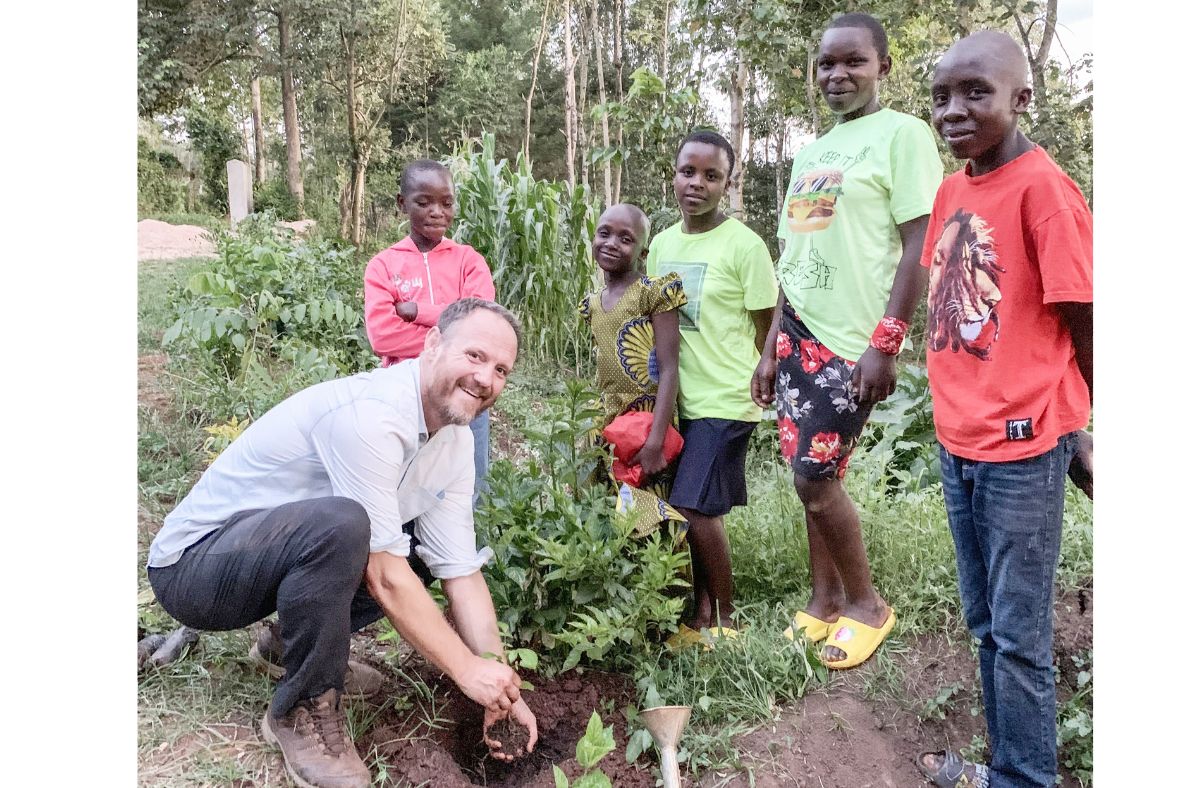
“I was out there in August and we’ve got agreements with 200 local farmers, they’re all signed up and they’ve agreed that we can plant up a strip of land adjacent to the river.”
There are specific species of trees that Sam and his fellow volunteers plant, including the waterberry, which plays a critical role in stopping erosion on riverbanks.
“It grows with its feet wet!” explained Sam.
“It’s like an inland mangrove and it acts like a sponge. It stops flooding and it stops erosion.
“If you go into the areas where the forest replanting has been successful, you are walking into a forest where the floor bounces. It’s like walking across a bog up in Teesdale but with trees!”
The projects Sam is involved with in Kenya are designed to be sustainable. The idea is to encourage farmers to grow crops that will return a profit while also benefitting the environment.
Of the 350,000 trees that will be planted, 50,000 will be fruit and nut trees, including 15,000 that grow avocados.
“We’re looking at extracting avocado oil from the avocados,” said Sam, “we’re also thinking about export markets. If all goes to plan it could be up to 50,000 avocado trees going in this year, but they take four or five years to come on line.”
And there’s beehives. However, the African species is nothing like the much-loved British bumblebee.
“There’s a massive local market for honey over there, but we’d also look to eventually exporting the honey,” explained Sam.
“Honey has the added value that the beehives are placed in a line between the cultivated land and our indigenous foresting.
“African honeybees are pretty fierce and they act like a living fence to keep the livestock out.
“I made the Channel 4 documentary Killer Bees, I was the researcher on that and discovered that they’ll kill a cow, so the cows won’t go anywhere near them!”
Sam and his team have even developed their own ketchup, which can potentially be monetised
in Kenya.
“There’s a fruit called tamarillo, which is known as the tree tomato. They are not actually tomatoes but they look quite like them.
“You can harvest them year after year, they grow really quickly and are resistant to crop raiding because the moneys don’t like the skins.
“They are what the farmers are crying out for, a cash crop. So, while I was out there in August, we experimented with four or five different batches of ketchup made out of tamarillos.
“We’ve developed this tamarillo ketchup and we put it into small pots and we trialed it with 100 farmers – it went down an absolute storm.
“There’s a big market for ketchup in Kenya and the ketchup they buy is poor quality and expensive so this would be a much less expensive, sustainable, tastier alternative.
“It’s all about helping the environment and benefitting from it at the same time.”
Sam plans to take students from Barnard Castle School to Kenya this summer and they won’t be there for a holiday, they will be working hands-on helping to produce environmentally friendly bricks!
The traditional method involves cutting down trees and burning wood over a pile of bricks to fire them. But Sam says there’s a much more sustainable way of manufacturing bricks.
“The fundraising at this end has mainly been through the Rotary Club of Teesdale and District Eco and through Barney School and with some of the funds, we’ve bought brick presses,” said Sam.
“It’s called the ISSB system – Interlocking Stabilised Soil Bricks. These machines basically look like enormous garlic presses and they produce a brick about the size of a breeze block.
“We use local subsoil – like a red clay – mixed with a bit of cement and sand. So from one bag of cement you get about 60 blocks.
“Around 10 trees get cut down for every pile of bricks to fire them, so it’s a massive driver for deforestation and that’s why we’re promoting ISSB technology.
“We’re making a school building with it but mainly we’re doing water tank construction,” he continued.
“One of the presses we’ve bought produces curved bricks, they’re like Lego blocks and they all fit together and they form a 20,000-litre water tank.
“So, this is what we’re going to be doing when we go out in the summer.
“We’ll get some of our kids producing bricks by swinging on the ends of the presses. The bricks cure over three days and then it’s like a breeze block and two people can produce about 500 of those a day.”
So, after working so hard for so many years – and with much more work still to do – how does Sam reflect on his lifelong commitment to Kenya?
“It’s so rewarding, it’s amazing,” he answered, before adding: “It’s frustrating as well, after all, it is Africa and we don’t get excited about anything until we’ve got the results on the table.
“Ultimately, it’s all about finding ways of working with communities to help them develop their own solutions to living alongside nature.”
That’s a view endorsed by Sam’s friend and fellow campaigner Maurice, who added: “We aim to be a beacon of hope, showing conservation with the people, and by the people, works best for both humans and wildlife.”